
Acorn Identification Chart: 12 Oak Species by Their Nuts
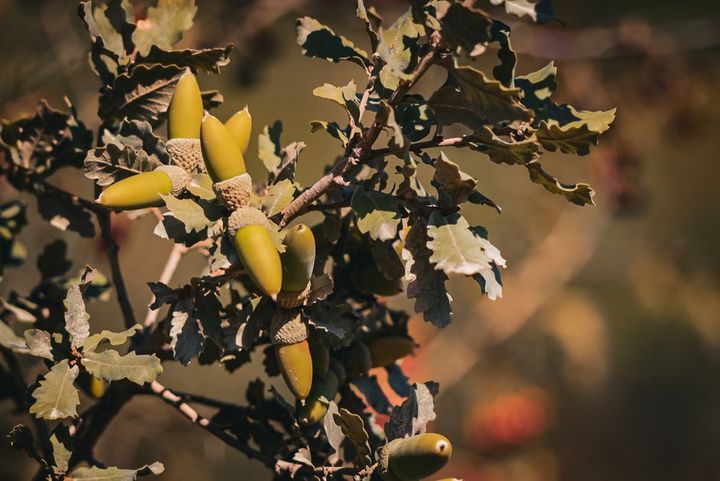
Photo by İrem Çevik / Pexels
Acorn identification comes down to three things: the cap, the nut, and the size. Every oak in North America produces a slightly different acorn, and once you learn to read the cup scales and nut shape, you can often name the tree from a single nut on the ground. This guide gives you a cap-and-nut chart for 12 common oak species, plus the one split that sorts most acorns before you even reach for details.
The fastest shortcut is the white oak versus red oak divide. It cuts the field of possibilities roughly in half in a few seconds, and everything else builds from there.
What an acorn tells you
An acorn has two parts: the cup (also called the cap), and the nut underneath it. Both carry identification clues, and so does the overall size. Before you compare an acorn to any chart, look at these four features.
- Cup depth and coverage. Does the cap sit like a shallow beret covering just the tip, or a deep bowl wrapping half the nut? Coverage is one of the most reliable species clues.
- Cup scale texture. Run a thumb over the cap. Scales can be flat and tight, warty and bumpy, or loose with a fringed, mossy margin around the rim.
- Nut shape. Acorns range from nearly round to long and torpedo-shaped. Note whether the tip is rounded, pointed, or flat.
- Size. Common acorns run from under half an inch to more than an inch and a half. Size alone rarely names a species, but it quickly rules several out.
One more feature is worth checking if you can turn the cap over. The inside of a white oak group cap is smooth and hairless. The inside of a red oak group cap is lined with fine, velvety hairs. That single detail confirms which half of the oak family you are looking at.

Found an acorn and want to know the oak? Fieldbook identifies trees, nuts, and leaves from a photo, and works offline on the trail. Logs each find with GPS so you can return to the tree. Free to try.


White oak vs red oak acorns: the first split

Photo by Vladimir Srajber / Pexels
Every oak belongs to one of two big groups, and their acorns behave differently. Learning this split first makes the rest of identification much faster.
White oak group acorns
White oak acorns mature in a single growing season, so the acorn on the tree in autumn started as this spring's flower. The caps tend to be shallow and bumpy or warty, and the nuts are usually oblong with a sweeter, lower-tannin taste that wildlife strips quickly. The inside of the cap is smooth. White oak, bur oak, swamp white oak, post oak, chestnut oak, and live oak all sit in this group.
Red oak group acorns
Red oak acorns take two seasons to ripen, so a red oak in autumn carries both this year's tiny immature acorns and last year's mature ones. The caps are often shallow and saucer-like with flat, tight scales, and the nuts are rounder and more bitter. The inside of the cap is fuzzy. Northern red oak, pin oak, black oak, scarlet oak, willow oak, and southern red oak belong here.
Quick test: shallow saucer cap, round bitter nut, fuzzy cap lining, two-year ripening equals red oak group. Deep or bumpy cap, oblong sweeter nut, smooth cap lining, one-year ripening equals white oak group.
Acorn identification chart: 12 oak species
This chart covers the oaks you are most likely to find in yards, parks, and forests across North America. Use the white oak or red oak group first to narrow the list, then match the cap and nut. Sizes refer to the nut length, not including the cap.
| Species | Group | Cup (cap) | Nut shape and size | Ripens in |
|---|---|---|---|---|
| White oak (Quercus alba) | White | Shallow, warty, covers about 1/4 | Oblong, light brown, 0.5 to 1 in | 1 year |
| Bur oak (Q. macrocarpa) | White | Deep bowl with fringed mossy rim, covers 1/2 or more | Broad and large, 1 to 1.5 in | 1 year |
| Swamp white oak (Q. bicolor) | White | Covers about 1/3, slightly fringed, on a long stalk | Oval, light brown, about 1 in | 1 year |
| Post oak (Q. stellata) | White | Coarse knobby scales, covers about 1/3 | Stubby oval, 0.5 to 0.75 in | 1 year |
| Chestnut oak (Q. montana) | White | Thin bowl, covers about 1/3 | Large, glossy dark brown, 1 to 1.5 in | 1 year |
| Live oak (Q. virginiana) | White | Shallow, tapered toward the stalk | Elongated and pointed, dark, 0.5 to 1 in | 1 year |
| Northern red oak (Q. rubra) | Red | Shallow flat saucer, covers only the tip | Broad oblong, 0.75 to 1.25 in | 2 years |
| Pin oak (Q. palustris) | Red | Thin saucer, covers about 1/4 | Nearly round, small, often striped, under 0.5 in | 2 years |
| Black oak (Q. velutina) | Red | Loose scales with a hairy fringe, covers about 1/2 | Oval, reddish-brown, 0.5 to 0.75 in | 2 years |
| Scarlet oak (Q. coccinea) | Red | Deep bowl, covers 1/3 to 1/2 | Rounded, concentric rings at the tip, 0.5 to 0.75 in | 2 years |
| Willow oak (Q. phellos) | Red | Thin and shallow | Small and round, almost pea-like, under 0.5 in | 2 years |
| Southern red oak (Q. falcata) | Red | Shallow, covers about 1/3 | Round, orange-brown, about 0.5 in | 2 years |
The two extremes are easy anchors. A bur oak acorn is unmistakable: it is the largest native acorn, sometimes as wide as a golf ball, wrapped in a deep cap with a shaggy fringe. A willow oak acorn is at the other end, a tiny round nut barely larger than a pea. Everything else falls between them.
Reading the cap: scales, depth, and texture

Photo by Lou Davis / Pexels
The cap is where the strongest clues live, because cap scales vary far more between species than nuts do. Three things to read on any cap:
- Coverage. Estimate how much of the nut the cap wraps. A quarter, a third, a half, or more. Bur oak and black oak wrap deeply. Northern red oak and pin oak barely cap the tip.
- Scale shape. Flat and pressed tight against the cap points to the red oak group. Raised, knobby, or warty scales point to the white oak group.
- The rim. A fringed or mossy edge around the cap margin is the bur oak signature. A clean, smooth edge is more typical of red oaks.
Caps often separate from the nut on the ground, so you may find loose caps and bare nuts near each other. A loose cap on its own is still worth reading, since the fringe, depth, and scale texture are all preserved.
Nut shape and size by species

Photo by Valeriia Miller / Pexels
Once the cap has pointed you toward a group, the nut narrows it further. A few shapes are distinctive enough to name on their own.
- Long and torpedo-shaped: live oak. The nut tapers to a point and is noticeably longer than it is wide.
- Very large and broad: bur oak and chestnut oak. Both produce heavy nuts over an inch long.
- Nearly spherical and small: pin oak, willow oak, and southern red oak. Round nuts under half an inch.
- Striped or ringed at the tip: pin oak often shows fine dark stripes, and scarlet oak shows concentric rings circling the tip.
Color helps at the margins but shifts as acorns dry, so treat it as a soft clue. Fresh acorns are often green, tan, or reddish, then darken to brown as they cure on the ground.
Matching an acorn back to its oak tree

Photo by Natalia Sevruk / Pexels
An acorn on the ground almost always fell from the tree above it or nearby, so the leaves overhead are your confirmation. The same white oak versus red oak split shows in the leaves: white oak group leaves have rounded lobes with no bristles, while red oak group leaves have pointed lobes tipped with a fine bristle. If your acorn says red oak group and the leaves above have bristle-tipped points, the two agree.
When the cap, nut, and leaf all line up, you have a confident identification. For the leaf side of the check, our oak tree leaves identification guide breaks down lobe shape, sinus depth, and bristle tips species by species, and it pairs naturally with the acorn chart above.
When and where to find acorns

Photo by Gundula Vogel / Pexels
Acorns drop in autumn, with most species falling from September through November across the United States, Canada, and the United Kingdom. White oak acorns tend to drop a little earlier, often in September, while many red oaks hold on into late October. Warm regions like the southern range of live oak can extend the drop later still.
The best hunting is simply under a mature oak after the first cold snap or a windy day, when a fresh layer of nuts covers the ground. Oaks also have mast years, when a tree produces a huge crop, followed by lean years with almost none, so a bare autumn under one tree does not mean you have the wrong species. Look at the forest floor, the base of the trunk, and any leaf litter caught along curbs or trail edges where acorns collect.
Acorns and their common lookalikes
A few nuts get confused with acorns, and the difference matters because none of them come from oaks.
- Horse chestnut and buckeye. These are round, glossy brown seeds inside a spiny or leathery husk, with no cup or cap. They are larger and smoother than acorns, and they grow on Aesculus trees, not oaks. Unlike acorns, they are toxic to people.
- Beechnuts. Small triangular nuts held in a soft spiny husk that splits into four parts. No round cup.
- Hazelnuts. Rounded nuts wrapped in a leafy, frilled bract rather than a scaly cap.
If a nut has a scaly cup that lifts off cleanly to reveal a smooth, unbroken nut, it is an acorn. If the husk is spiny, leathery, or splits into segments, it is one of the lookalikes.
Tip: photograph the acorn from the side with the cap on, then take a second shot of the cap turned over so the lining shows. A tree identification app like Fieldbook can suggest a species from that photo, and the entry saves GPS coordinates and the date so you can return to the same oak when leaves confirm the ID.
Frequently asked questions

Photo by Christina & Peter / Pexels
How do you identify an acorn?
Look at three features: the cap depth and scale texture, the nut shape, and the size. Start by sorting into white oak group (shallow bumpy caps, oblong nuts, smooth cap lining) or red oak group (flat saucer caps, rounder nuts, fuzzy cap lining), then match the cap and nut to a species chart.
What is the difference between white oak and red oak acorns?
White oak acorns mature in one year, have shallow warty caps, oblong nuts, and a smooth cap lining. Red oak acorns take two years to ripen, have flat saucer-like caps, rounder and more bitter nuts, and a fuzzy, hairy cap lining. Turning the cap over to check the lining is the quickest confirmation.
Can you identify an oak tree from its acorn alone?
Often yes, at least to the group and frequently to the species. Cap coverage, scale texture, and nut shape are distinctive enough that bur oak, live oak, willow oak, and several others can be named from the nut. For a firm identification, check the leaves overhead, which fell from the same tree.
What does a bur oak acorn look like?
Bur oak produces the largest native acorn, sometimes over an inch and a half long. The nut is broad and the cap is deep, wrapping half or more of the nut with a distinctive shaggy, mossy fringe around the rim. Nothing else looks quite like it.
When do acorns fall?
Most acorns drop from September through November. White oak group acorns tend to fall earlier, often in September, while many red oaks drop into late October. Oaks also have mast years with heavy crops followed by lean years, so the amount varies from season to season.
Are acorns edible?
Raw acorns contain bitter tannins and are not eaten straight from the tree. White oak group acorns have lower tannin levels than red oak group acorns. Any preparation for eating involves leaching out the tannins first. This guide is about identification, not foraging, so treat edibility as a separate topic and consult a dedicated wild-food source before eating anything you find.
Why do some acorns have caps and some do not?
The cap and nut separate easily once an acorn is ripe, so on the ground you often find bare nuts and loose caps near each other. A loose cap is still useful for identification because its depth, fringe, and scale texture are preserved.
Can a tree identification app identify oaks from an acorn photo?
Yes. Apps that use AI image recognition can suggest a species from a clear acorn photo, especially when the cap is visible. Fieldbook lets you photograph an acorn, get an identification, and save the result with GPS location and notes so you can revisit the tree.
Related guides
Keep going with more identification guides: oak tree leaves identification for confirming the tree overhead, maple tree identification for the other classic autumn tree, and tree bark identification for naming trees in winter once the leaves and acorns are gone. To photograph and log your finds in the field, see the plant identification app and the offline nature journal.
A clear photo of the cap and nut is often enough to sort an acorn to its oak. Fieldbook identifies trees and nuts from photos and logs each find with GPS coordinates.
