


Remember what you found, where, and when
Foraging knowledge builds over seasons. Fieldbook keeps each observation tied to its place, date, photos, habitat notes, and identification context so patterns are easier to spot later.
- Track mushrooms, berries, herbs, nuts, roots, greens, fruits, trees, and plants.
- Save repeat spots on a private discovery map.
- Organize entries by trip, habitat, season, or collection.
Safety note: Use Fieldbook for journaling and research. Never eat wild plants or mushrooms based only on an app or AI suggestion.
Private spot map
Keep track of promising areas and revisit them when the season is right.
Season notes
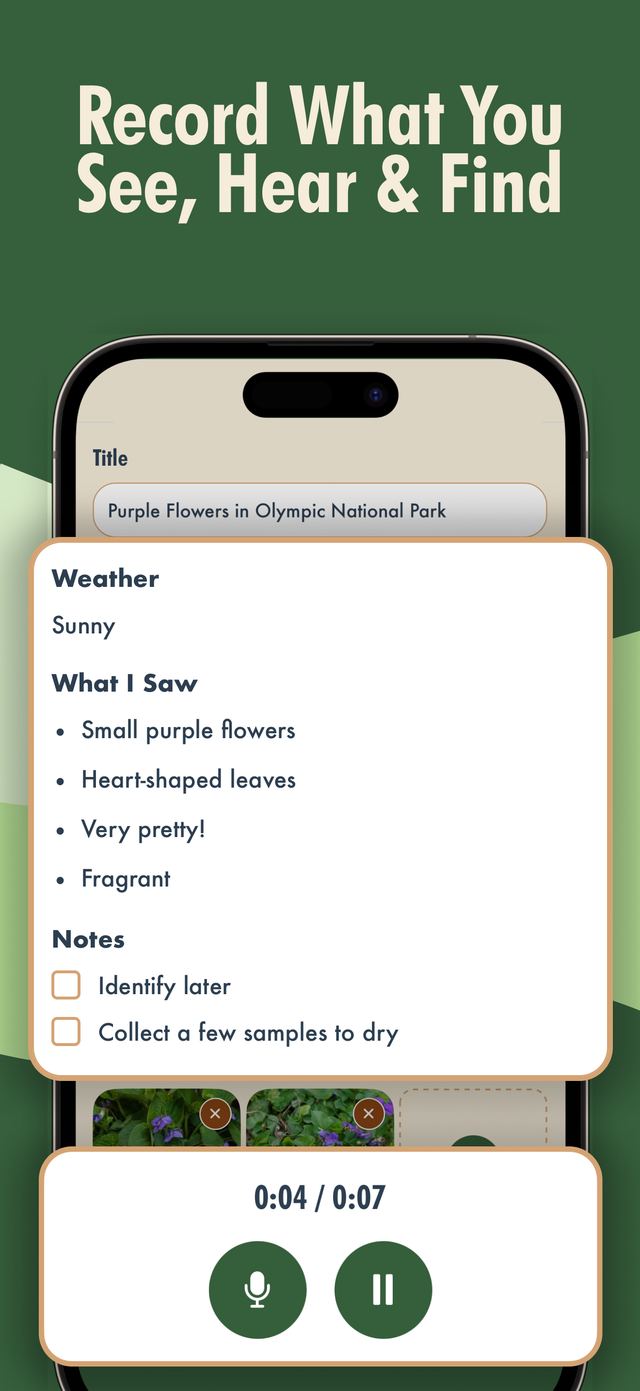
Record weather, habitat, nearby trees, and other clues that matter next year.
Broad identification
Use Fieldbook across mushrooms, berries, herbs, nuts, flowers, trees, and more.
Built for foragers who return to the same areas
Foraging knowledge compounds over time. A patch of ramps that appears in April, a cluster of chanterelles under the same oaks each July, a hedgerow of elderberries along a familiar trail. The value of a foraging journal is not the single find but the pattern across seasons and years.
Fieldbook keeps each observation tied to a GPS pin, so you can filter the map by category, date range, or collection. Entries also store weather data and habitat notes, which helps you predict when a spot will produce again.
Foraging is one of 19 categories in Fieldbook. You can also track mushrooms, plants, trees, birds, insects, and more in the same journal. For a comparison of foraging tools, read our guide to the best foraging apps.
Why keep a foraging journal at all?
Foraging rewards memory more than almost any outdoor activity. Wild garlic, elderflower, blackberries, sloes, and chanterelles each have a window of a few weeks, and each returns to roughly the same ground year after year.
Without a record you rebuild that knowledge every season from scratch. With one, the second year is easier than the first and the fifth is easier still. What you want is not a list of names, it is a map of places with dates attached.
- Exact location: GPS tagged and private, so you can walk back to the spot rather than the general area.
- Date: the single most useful field, because timing repeats closely year to year.
- Habitat notes: which trees were nearby, how much light, how wet the ground was.
- Quantity and condition: whether it was worth the walk, and whether you were early or late.
- Photos: so you can confirm what you found and compare against next year.
Are your foraging spots private?
Yes, and this is the reason many foragers avoid community identification apps. Entries and their locations belong to your account and are not published to any public map.
A productive patch stops being productive once it is shared widely. Fieldbook is built as a private notebook first, with sharing as a deliberate choice on a single entry rather than the default.
| What you want to do | Community ID app | Fieldbook |
|---|---|---|
| Identify a find from a photo | Yes | Yes |
| Keep the location private | Often published | Private by default |
| Record habitat and host tree | Rarely | Text and voice notes |
| Track when a patch produces each year | No | Entries sorted by date |
| See your own spots on one map | No | Private discovery map |
| Work deep in woodland with no signal | Usually not | Full offline journaling |
| Group a season's finds together | No | Collections |
What can you safely decide from an app?
An app can narrow the field and keep your record. It cannot tell you that something is safe to eat, and Fieldbook does not claim to.
This matters most with fungi, where several deadly species have close edible lookalikes, and with umbellifers, where poison hemlock resembles several harmless plants. Fieldbook flags known toxic lookalikes alongside a suggestion. Confirm anything you intend to eat with a regional field guide or a person who knows the species in front of them.